LNG transportation
Domestic LNG imports 4.69 million tons per year
Hyundai LNG Shipping is in charge of transporting 469 tons of domestic LNG imports through its long operating experience in the LNG transportation business.
Shale gas transportation
The shale gas vessel to lead the global LNG market
In response to the shale gas revolution growing worldwide, we have achieved 2 orders of shale gas vessels in 2014. We have been successfully introducing shale gas, which will lead the global LNG market, from the US Sabine Pass area since 2017.
Vessel Information
Puteri Mayang
174,000m3
- Built Year/Yard2025.01 / HHI
- Tank TypeMembrane type
- FlagMarshall
- PropulsionX-DF
- Service Route Worldwide
- Cargo Capacity174,000m3
Puteri Mahsuri
174,000m3
- Built Year/Yard2024.11 / HHI
- Tank TypeMembrane type
- FlagMarshall
- PropulsionX-DF
- Service Route Worldwide
- Cargo Capacity174,000m3
Puteri Sejinjang
174,000m3
- Built Year/Yard2024.07 / HHI
- Tank TypeMembrane type
- FlagMarshall
- PropulsionX-DF
- Service Route Worldwide
- Cargo Capacity174,000m3
Puteri Santubong
174,000m3
- Built Year/Yard2024.07 / HHI
- Tank TypeMembrane type
- FlagMarshall
- PropulsionX-DF
- Service Route Worldwide
- Cargo Capacity174,000m3
Puteri Ledang
174,000m3
- Built Year/Yard2024.04 / HHI
- Tank TypeMembrane type
- FlagMarshall
- PropulsionX-DF
- Service Route Worldwide
- Cargo Capacity174,000m3
Puteri Saadong
174,000m3
- Built Year/Yard2024.02 / HHI
- Tank TypeMembrane type
- FlagMarshall
- PropulsionX-DF
- Service Route Worldwide
- Cargo Capacity174,000m3
HLS Cartagena
174,000m3
- Built Year/Yard2024.06 / Hanwha Ocean
- Tank TypeMembrane type
- FlagMalta
- PropulsionME-GI
- Service Route Worldwide
- Cargo Capacity174,000m3
HLS Bilbao
174,000m3
- Built Year/Yard2024.02 / Hanwha Ocean
- Tank TypeMembrane type
- FlagMalta
- PropulsionME-GI
- Service Route Worldwide
- Cargo Capacity174,000m3
Blue Whale
7,500m3
- Built Year/Yard2023.05/HHI
- Tank TypeKC-2
- FlagLiberia
- PropulsionAzimuth Thruster
- Service Route Domestic
- Cargo Capacity7,500m3
HYUNDAI Peacepia
174,000m3
- Built Year/Yard2017.06 / Hanhwa Ocean
- Tank TypeMembrane
- FlagPanama
- PropulsionME-GI
- Service Route USA (Sabine pass)
- Cargo Capacity174,000m3
HYUNDAI Princepia
174,000m3
- Built Year/Yard2017.05 / Hanhwa Ocean
- Tank TypeMembrane
- Flag Panama
- PropulsionME-GI
- Service Route USA (Sabine pass)
- Cargo Capacity174,000m3
HYUNDAI Oceanpia
137,200m3
- Built Year/Yard2000.07 / HHI
- Tank TypeMoss type
- FlagPanama
- PropulsionSteam Turbine
- Service Route Oman (Qalhat)
- Cargo Capacity137,200m3
HYUNDAI Aquapia
137,141m3
- Built Year/Yard2000.03 / HHI
- Tank TypeMoss type
- FlagPanama
- PropulsionSteam Turbine
- Service Route Worldwide
- Cargo Capacity137,141m3
HYUNDAI Cosmopia
137,219m3
- Built Year/Yard2000.01 / HHI
- Tank TypeMoss type
- FlagPanama
- PropulsionSteam Turbine
- Service Route Worldwide
- Cargo Capacity137,219m3
HYUNDAI Technopia
137,219m3
- Built Year/Yard1999.07 / HHI
- Tank TypeMoss type
- FlagPanama
- PropulsionSteam Turbine
- Service Route Worldwide
- Cargo Capacity137,219m3
HYUNDAI Utopia
127,244m3
- Built Year/Yard1994.06 / HHI
- Tank TypeMoss type
- FlagRepublic of Korea
- PropulsionSteam Turbine
- Service Route Idonesia (Bontang / Arun / Luwuk)
- Cargo Capacity127,244m3
Global Network
We have been working hard to expand, explore and find a variety of navigation routes to provide LNG to the world.
We will continue to develop as a global leader with our 31 years of LNG experience in the domestic market.
(The network areas below are based on the loading ports of shipment, and there are also worldwide LNG terminals on
the basis of discharging port.)

Moss
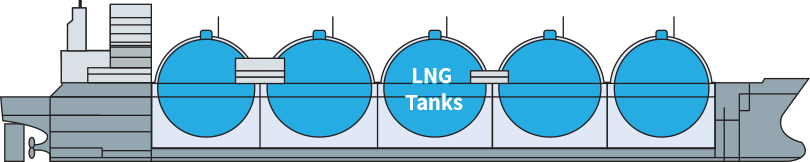
MOSS technology uses the form that has a spherical cargo window.
A Moss-type tank is separated from the vessel body and is designed to maintain pressure by shipping LNG inside the tank, which is independent of the hull.
The tank is designed to ensure safety in case of leakage by applying ‘Leak Before Failure’ concept
Membrane
A membrane-type vessel has a cargo window inside the ship.
Membrane method has been developed to overcome defects in older independent tanks and supports the internal LNG pressure and weight as well as the hull. This technique can increase the amount of mounting and minimize protrusion of upper armored plates. A Membrane-type vessel is also heat-efficient.


Moss guarantees high level of safety through internal pressure structure.
[ Section ]
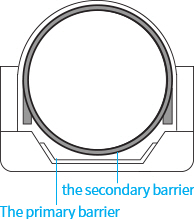
A Moss-type tank is separated from the vessel body and is designed to maintain pressure by shipping LNG inside the tank, which is independent of the hull. A Moss tank is spherical to minimize thermal intrusion at the same time as with high pressure. The components of the LNG tank that are exposed to extreme temperatures must be strong enough to maintain high pressure inside the tank even at extreme temperatures, so alloys that can withstand extreme temperatures are used. In the hull, the equator of the independent spherical tank is maintained at the top of the cylindrical metal tank support (skirt) and welded to the inner wall of the hold called the Cargo hold.
The advantages of Moss technology
- Moss has used ‘Leak Before Failure’ concept architecture. It shows durability against sloshing effect.
- In the event of cargo pump failure, emergency pressure reduction can be done without the need for a separate pump.
- Low external heat transfer rate ensures low LNG boil-off emission.
- Design lifetime is semi-permanent, being more than 100 years.
- It is easy to free up space for inspection or maintenance.
Membrane with improved space utilization at the dock.

[ Section ]
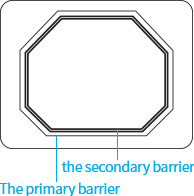
A membrane-type vessel has a cargo window inside the ship. Membrane method is developed to overcome defects in older independent tanks and supports the internal LNG pressure and weight as well as the hull. The outer wall of the tank is in close contact with the inner wall of the dock, and the thin tank only functions to maintain the air-seal and cryogenic temperature and the pressure or weight support will be taken care of by the hull. To use the square-shaped dock space efficiently, the protrusion from the upper deck is minimized. This also lightens the weight of the tank.
The advantages of Membrane technology
- Shipping capacity is increased due to good space utilization at the dock.
- Minimum upper deck protrusion provides better space availability and clear visibility.
- Due to the nature of the No.96 type, the heat shrink/expansion is very small and can be applied to sloped tanks.
ME-GI (MAN Diesel & Turbo Electronic Gas Injection Engine)
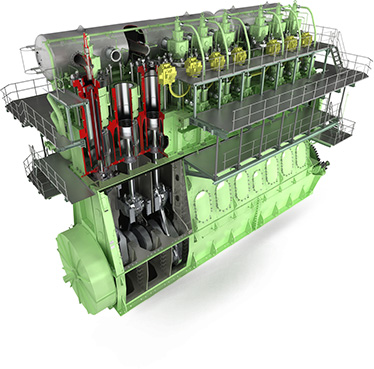
Type
5G70ME-C9.5-GI
ME-GI benefits
- low operational cost
- low investment cost
- flexible burning of HFO and gas
- conventional MAN B&W two-stroke technology
- 1) high reliability 2) low maintenance
- clean exhaust gas
- simple technology
- maximum engine room safety
- proven technology
- two-stroke dual fuel experience since 1994
Clean Exhaust Gas Emission